

The Buschenschank Experience
Where the table sits in the farm, the food tastes better, and conversations linger.

I suppose I didn’t know what to expect as we left Graz and began the hour-long journey into the heart of the Steiermark.
I do recall feeling excited as I stared out the backseat window in absolute awe. The hills ahead gradually began to swell into something larger, while the Koralpe mountain range loomed in the distance. As the road narrowed and we began the 25-kilometer ascent, I thought I could just about make out the first vineyards up ahead. The beginning of the Styrian Wine Road.
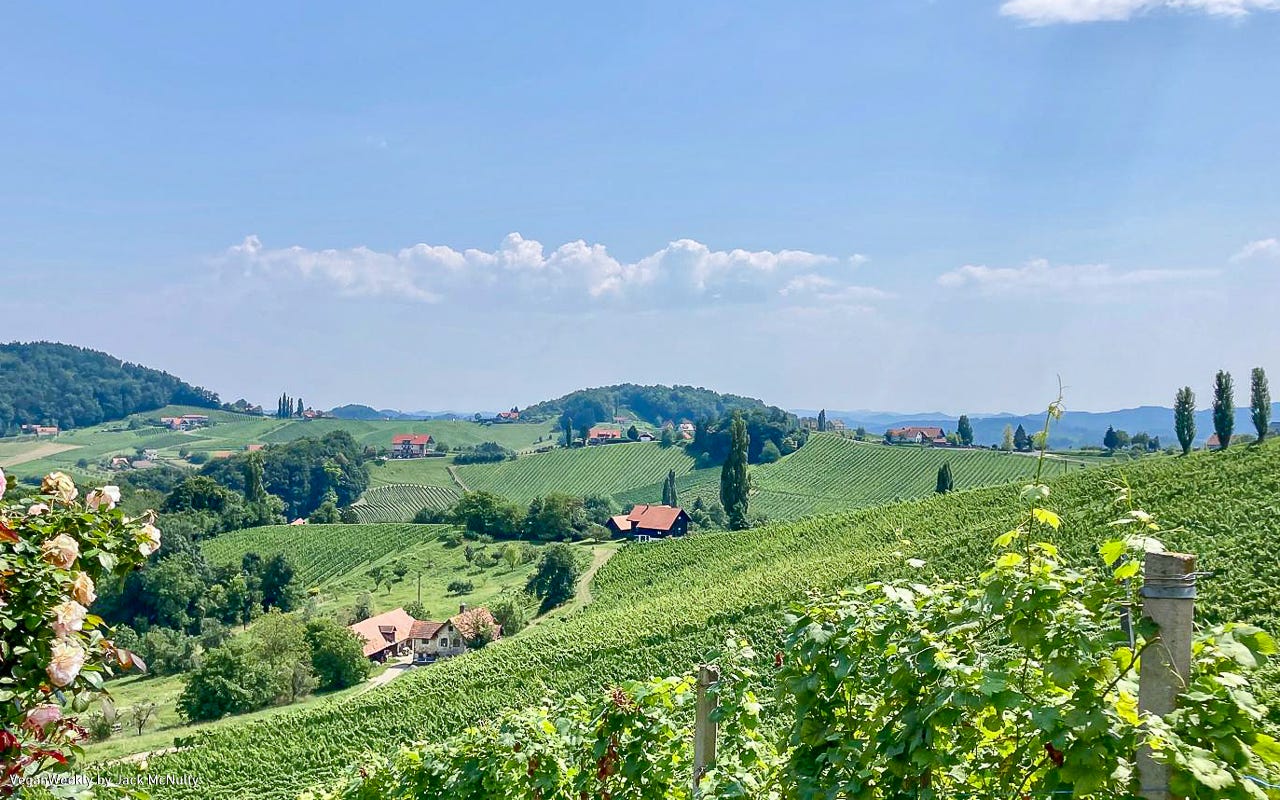
As we approached the summit of our climb, everything opened to reveal a dramatic sea of rolling, green hills capped by forested ridges. This portion of the road was also the physical border between Austria and Slovenia. I thought it was cool to travel along a road separating two countries by a farmer’s fence. Some refer to this area as the Styrian Tuscany. That’s easy to understand, but I think these regions deserve their own identity.
There were more bicycles on the road now, forcing us to slow our pace. That was fortunate. I was able to catch a glimpse of a Klapotetz (a traditional wooden windmill used to scare away birds, as I later discovered). Authentic.
The slopes were steep. I wondered how those tractors working in the fields kept from sliding off. The vineyards filled my eyes in every direction I looked. And nestled within them were Buschenschank taverns...our intended destination.
We came here mostly for the wine. Sauvignon Blanc...the crown jewel of Steiermark. But also Morillon, a distinctive Chardonnay rich in minerality and acids. The food seemed less promising because I knew it would mainly be platters of meats and cheeses. But once I made my way toward the picnic tables and sun sails and spotted the sign offering a tomato salad, I started to feel different about this experience.


This was not a restaurant or a tavern. It was more of a working farmhouse where a family lived, and workers came to grow and harvest things. And every Friday, Saturday, and Sunday during the summer and early Autumn, tables were put out, shade was organized, and both wine and food were on offer to anyone passing by...but only according to a centuries-old regulation that aims to prevent commercialization and ensure a direct, local connection to farming. This is the Buschenschank experience—a tradition that allows local wine producers to serve their own wines and simple cold foods made with products from their farm or neighboring farms. This is an authentic experience that puts the table right in the farm.
We ordered our wine. Delicious. Context was a main ingredient in these wines, but the fresh acidity was also welcome on this hot day. Our food arrived next. A colorful plate of red and yellow tomatoes adorned with fruity olive oil (from relatives in South Tirol, we were told), snipped basil from a plant a few meters away, and nuts. Another platter arrived, this one with slow-roasted beetroot, pumpkin seeds, and walnuts all sitting atop a kind of white cabbage. Large strands of freshly grated horseradish fell from the grater like cheese. The sharp and sweet aromas intermingled with the essence of the farm, chasing away the curious flies that started to gather. A large loaf of warm bread arrived on a cutting board—an obvious suggestion that the slicing would be our task.
Small bowls of bean salad followed the platters and bread. The beans were Styrian Käferbohne, large, dark beans with blotches of pink. The rest of the salad consisted of sliced green onions, more tomatoes, and horseradish. It was tossed with pumpkin seed oil (the world’s finest, according to me and those who know such things). The smooth creamy texture, and delicate nutty flavor of the beans paired beautifully with the sweet tomatoes, onions, sharp horseradish, and the boldness of the earthy pumpkin seed oil...and dare I say, it was a rich and buttery sensation I hope to never forget.


None of these offerings was plated to impress. The tomatoes were simply sliced, the beans spooned into a bowl with a few chopped ruby-colored tomatoes and sliced green onions, the bread left whole for us to tear at. There were no distracting garnishes strategically placed using tweezers. Everything was meant to be eaten, nothing traveled far, and nothing would be wasted. It was some of the most gratifying food I’ve relished...precisely because no one tried to make it more than it was.
“The popularity of ‘peasant cooking’ has seen us exalt dishes that were created specifically to use up leftover bread.” – Diana Henry
Later, as we were driving back toward Graz, feeling full and a bit sun-drunk, I kept circling back to a thought. Everything we had eaten would, by most people’s reckoning, be called peasant food. It was simple, inexpensive, and charmingly rural. But something was nagging me. I couldn’t work out why that word ‘peasant’ felt misplaced...as if praising and patronizing the food in the same breath.
Diana Henry puts her finger on it in her book Around the Table. She’s right, and there’s a quiet irony in it. We’ve taken the food born out of thrift and necessity and set it on a pedestal. It’s a compliment that arrives with a wink and a faint glance at the ground.
It seemed to me that the cooks who made our lunch weren’t simply making do. The horseradish was grated to order—occupying the same status as freshly grated white truffle. Perfectly ripe, fresh Käferbohne was the only option that could sit in the same bowl as the other ingredients—a sort of freshness pact that only those who grew them could understand. Even the pumpkin oil, made on the farm last autumn from the famous Steirischer Ölkürbis, stood alone as the sole option that could place an exclamation point on a dish no one else could produce. All of this was no accident. It wasn’t built from a place of thrift or necessity; it was knowledge...held onto and handed down through generations.
What’s special about the Buschenschank experience is that it’s unremarkable yet memorable in its simplicity. Everything about the experience felt generous and inclusive. It was an honest celebration without the need for labels.
Which brings me back home, and to a bowl of three Semmelknödel.
These bread dumplings belong to the same world as that rustic Buschenschank table. We visited in summer, but I’m told that just after the wine harvest, when the work eases, and the smell of fermenting grapes fills the air, these places hold a celebration. Workers and customers share the same table...and the Knödel platters come out.
It’s a humble offering made from leftover bread, an onion, and whatever greens and herbs are on hand. Sometimes it’s just that, bound together and poached. Other times, bits of smoky meat or cheese are included. But the point is the same, this is a dish specifically born from leftover bread, just as Diana Henry stated.
Those were the memory threads I carried back from the Buschenschank. Not a recipe, exactly...more a way of seeing and thinking. Nothing was wasted. No apologies for simplicity were necessary. It was simply allowing excellent ingredients to shine... things that were always nearby yet easily forgotten. I thought...this is me...this is how I want to cook at home.
My version of Semmelknödel is how it landed in the real world.
Please consider supporting my work through a paid subscription. Take advantage of my summer offer and receive a 25% discount for an annual subscription—a total of 22.50 euros. Your contributions help me keep this project running.
Thank you for being part of this growing community of thoughtful creators and mindful eaters.
Semmelknödel
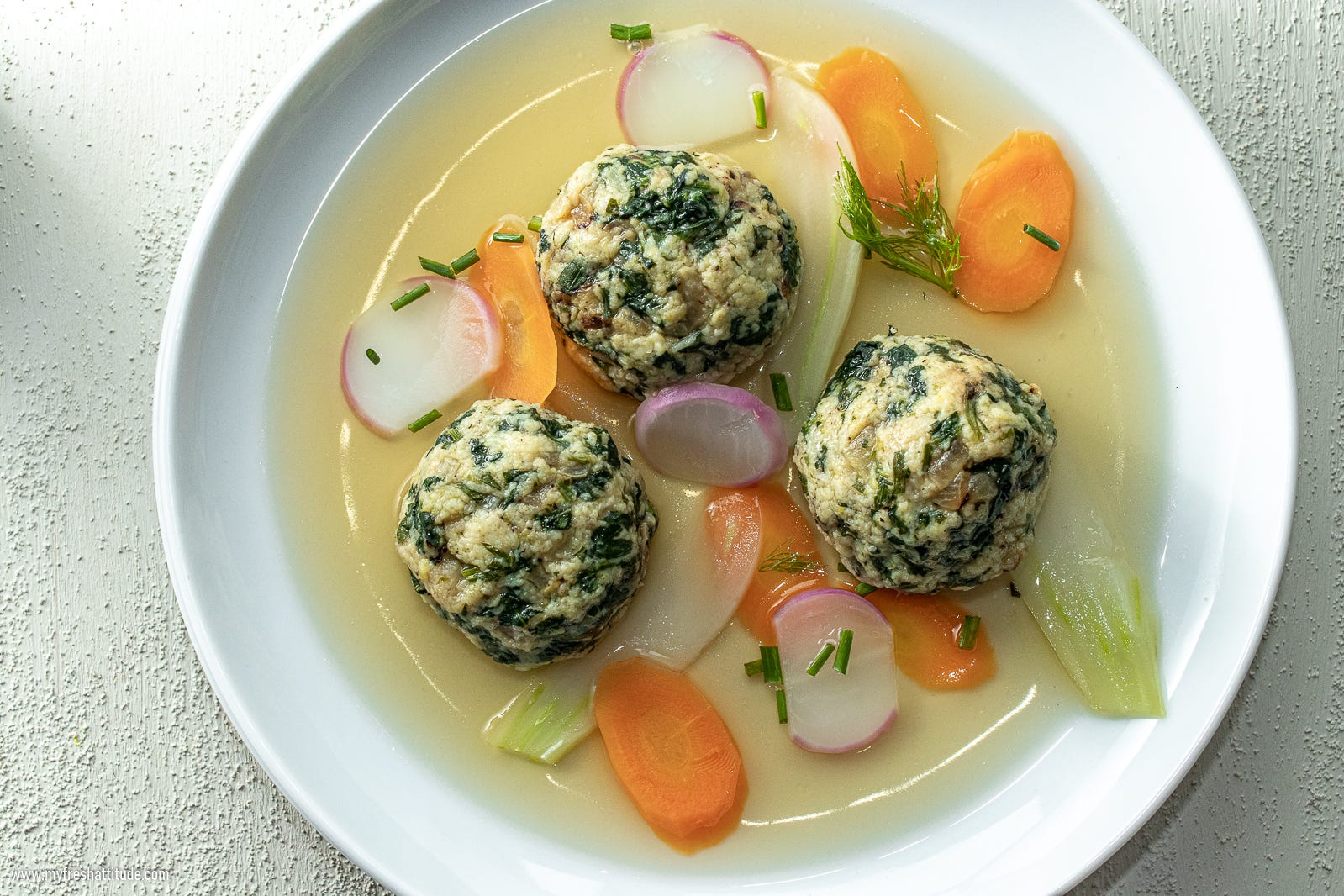
The version I make leaves out the egg that usually binds it. But the spirit and flavors are unchanged: yesterday’s bread becomes a dish worth setting in front of anyone. It’s a dish deserving praise, not a label. It’s the kind anyone would be glad to make.
Social Media
I’m no longer engaged with Facebook or Instagram. Please follow me on Bluesky to stay connected on social media.
I grew up in Hartberg, you discribe the Buschenschank culture much better than i ever could have. Thank you. I had to laugh with you on your explanation of how we handle horseradish -freshly grated, because thats exactly what i did for my clients in Aspen,they always loved it! On the dumplings, we used to do them with fresh stinging nettles, wild herbs and flexseed -eggs. Great article, thanks!
Fascinating writing. Reminds me of some remote farmhouses in the Pyrenees that you arrive at on foot, for a delicious, simple and only occasional 'peasant' meal; or at least that's how it was 40 years ago!
I love the dishes, and will try the Semmelknödel recipe you include. Thank you, Jack.